.png?x-oss-process=image/resize,h_100,m_lfit/format,webp)
.png?x-oss-process=image/resize,h_100,m_lfit/format,webp)
.png?x-oss-process=image/resize,h_100,m_lfit/format,webp)

Across commercial fleets and independent workshops, the most expensive brake failures rarely start with a “bad part.” They start with small installation shortcuts: a hub face that wasn’t fully cleaned, a locating hole that’s slightly off-center, a disc that was “skimmed” without proper setup. Overseas customers—especially fleet managers—tend to report the same pattern: noise → vibration → uneven wear → downtime. In the worst cases, they report reduced braking stability under high load.
Commercial vehicles operate with higher gross weight, longer heat cycles, and tighter uptime requirements. A passenger car might tolerate minor runout for months; a heavy-duty truck often turns it into steering shake, brake judder, accelerated pad taper, and unplanned service stops.
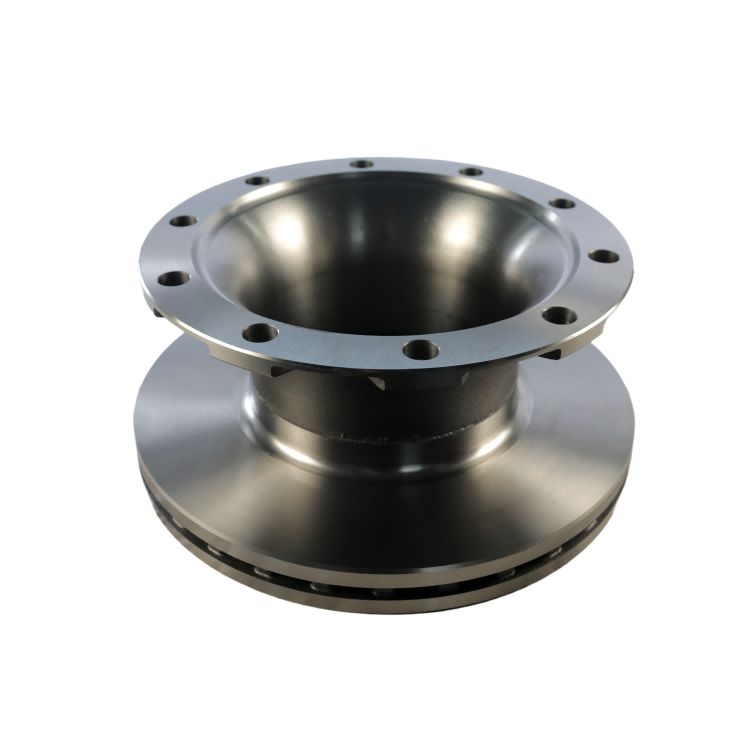
Field feedback from overseas markets frequently points to two technical triggers that are underestimated during installation and rework: locating hole accuracy (how precisely the disc centers on the hub) and machining/turning quality (how the friction faces are cut and finished).
“We replaced discs twice in one quarter. The second set was fine, but the vibration returned after 2–3 weeks. The final fix was cleaning the hub and correcting disc centering—parts were not the real issue.”
“Local machining removed the noise for a short time, then pads started wearing unevenly. We found the disc was turned without proper mounting, and the surface finish was too rough.”
Many technicians focus on bolt torque and pad bedding, yet ignore disc centering. On numerous commercial platforms, the brake disc relies on a hub pilot / locating feature to center accurately. If the disc’s locating hole tolerance is loose or off-axis, the disc can sit slightly eccentric even when bolts are tightened correctly.
A typical complaint is “brake judder at 60–90 km/h” or “steering shake under light braking.” Technically, it often links to lateral runout that turns into disc thickness variation (DTV) over time. Industry references commonly treat 0.05 mm as a practical upper threshold for lateral runout on many road vehicles; on heavy-duty applications, fleets often set even tighter internal targets due to higher load sensitivity.
Note: The same symptom can have multiple causes. The fastest troubleshooting path is to verify centering and runout before replacing parts again.
Rust scale, paint overspray, trapped grit, and old gasket residue can behave like an invisible shim. It takes only a small high spot to create measurable runout. In overseas aftersales reports, a large share of “defective disc” claims end up traced back to installation surface contamination.
Disc turning (machining) is not automatically wrong—many fleets use it to stabilize braking feel and extend service life. The risk is when machining is performed without controlling mounting accuracy, parallelism, and surface finish. Overseas customers often describe a short-term improvement followed by noise, hot spotting, or rapid DTV.
1) Setup alignment: If the disc is not mounted true to its working center (especially when the locating hole fit is inconsistent), the cut can be concentric to the machine but not concentric to the hub—judder returns.
2) Surface condition: A rough or directional finish can excite pad vibration and increase bedding time. Many workshops aim for a consistent, controlled surface texture and then follow a disciplined bedding-in procedure; skipping that step is a common reason “newly machined” discs squeal.
Good installation cannot fully compensate for poor geometry. That is why many overseas buyers now request evidence of process control rather than only “material grade.” A brake disc with stable centering features and consistent machining reduces the probability of vibration sensitivity in real-world conditions.
From a manufacturing perspective, adopting IATF TS16949-certified materials and a precision turning process helps control key geometry from the source—especially on commercial vehicle brake discs where centering accuracy and face parallelism are critical. In practical terms, it means fewer “mystery” complaints where the workshop replaces parts repeatedly yet the root cause is geometric inconsistency.
The following steps reflect what many high-performing fleets implement to reduce repeat repairs and warranty friction. They are intentionally simple, because consistency beats complexity.
Many fleets report fewer vibration-related complaints when they document runout readings at installation—helpful for both quality tracking and supplier communication.
Which issue do you see most often in your market—noise, judder, or uneven pad wear? And when you investigate, is the root cause usually hub preparation, locating/centering, or machining quality?
If you are sourcing commercial vehicle brake discs and want more consistent centering and stable machining quality, choose a supplier that controls geometry from the start—using IATF TS16949-certified materials and precision turning to minimize installation-sensitive failures.
Get the Commercial Vehicle Brake Disc Spec Sheet & Installation GuideRecommended for fleet managers, workshop owners, and importers who need fewer vibration claims and clearer quality documentation.
 175
|
175
|
 Anti-rust brake discs Brake disc wear resistance High-compatibility brake discs Commercial vehicle brake system upgrade Brake disc anti-corrosion technology
417
|
Brake disc installation myths Positioning hole precision Turning and grinding processes Commercial vehicle brake discs Braking system safety
228
|
Brake disc adaptability High - precision positioning holes European E - mark certification OEM brake disc customization Brake system interface compatibility design
265
|
IATF TS16949 automotive brake hub manufacturing quality management system supply chain quality control OEM supplier certification
133
|
international brake kit certification VCA COP audit EMARK certification automotive braking system safety automotive parts industry standards
Anti-rust brake discs Brake disc wear resistance High-compatibility brake discs Commercial vehicle brake system upgrade Brake disc anti-corrosion technology
417
|
Brake disc installation myths Positioning hole precision Turning and grinding processes Commercial vehicle brake discs Braking system safety
228
|
Brake disc adaptability High - precision positioning holes European E - mark certification OEM brake disc customization Brake system interface compatibility design
265
|
IATF TS16949 automotive brake hub manufacturing quality management system supply chain quality control OEM supplier certification
133
|
international brake kit certification VCA COP audit EMARK certification automotive braking system safety automotive parts industry standards