.png?x-oss-process=image/resize,h_100,m_lfit/format,webp)
.png?x-oss-process=image/resize,h_100,m_lfit/format,webp)
.png?x-oss-process=image/resize,h_100,m_lfit/format,webp)

In the procurement of automotive safety components, the quality of brake discs directly affects driving safety and brand reputation. This article will provide a comprehensive guide, from appearance details and material standards to international certifications, to help you identify high-quality brake discs, avoid low-price traps, and offer professional reference for your purchasing decisions.
In automotive braking systems, brake discs play a crucial role as the "last line of defense." Industry statistics show that approximately 23% of traffic accidents are directly related to braking system malfunctions, and 40% of these can be traced back to brake disc quality issues. For B2B buyers, choosing high-quality brake discs is not only a commitment to customer safety but also a long-term investment in their own brand reputation.
The price difference of brake discs in the market can be 3-5 times. Many buyers choose low-priced products to reduce costs, but they ignore the potential risks. Inferior brake discs may deform, vibrate, and make abnormal noises after 3-6 months of use. This not only increases after-sales costs, but may also cause serious safety accidents and result in incalculable losses.
High-quality brake discs should have a surface flatness error controlled within 0.05mm/m . The surface should feel smooth to the touch, without any bumps or unevenness. You can place the brake disc flat on a level surface and observe its fit; smaller gaps indicate higher processing precision. Some manufacturers use laser flatness testing to ensure that every product meets stringent standards.
High-quality brake discs typically employ a three-layer electroplating process (zinc layer + nickel layer + protective layer) or a high-temperature ceramic coating, resulting in uniform thickness and strong adhesion. During inspection, pay attention to the edges of the disc and the area near the heat dissipation holes, as these areas are most prone to uneven coating. You can lightly scratch the coating with your fingernail; high-quality products should not show any peeling and should remain rust-free for over 12 months under normal operating conditions.
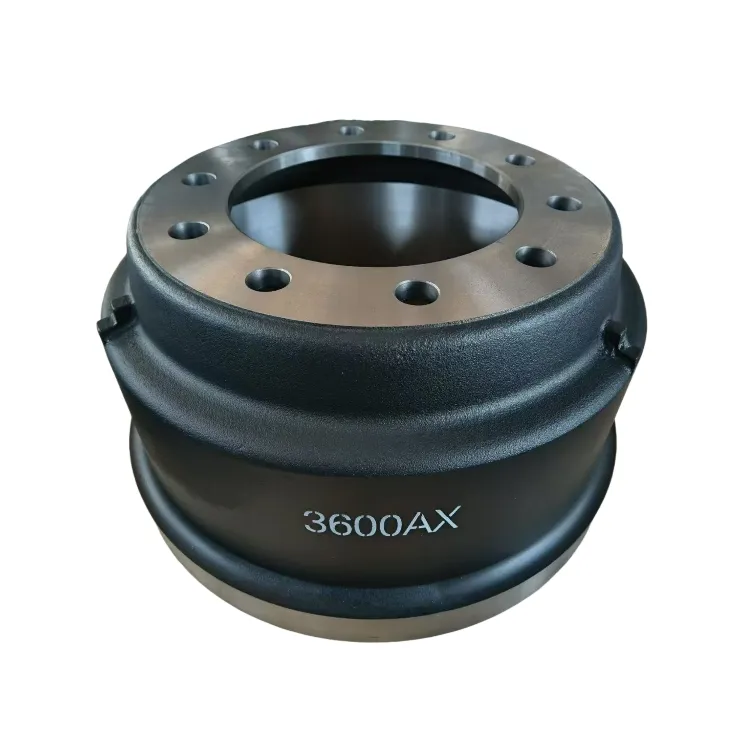
High-quality brake discs have all edges finely chamfered, free of burrs and sharp edges, preventing scratches to operators or damage to brake pads during installation. Pay special attention to the area around the cooling holes; high-quality products have smooth, burr-free hole walls and uniform hole diameter, while inferior products often cut corners in this area, resulting in rough edges or uneven hole diameters.
High-quality brake discs must undergo a rigorous heat treatment process, including overall tempering and surface hardening . By heating to a high temperature of 850-900℃ and then rapidly cooling, the surface hardness of the disc is increased by 30-40%, while the core retains good toughness. This "hard on the outside and tough on the inside" characteristic can extend the service life of the brake disc to 60,000-80,000 kilometers , far exceeding the 20,000-30,000 kilometers of inferior products.
You can judge the quality of heat treatment by observing the color of the brake disc cross-section: high-quality products have a uniform silver-gray cross-section with no obvious color difference; while products that have not undergone sufficient heat treatment have uneven colors on the cross-section and are prone to problems such as local overheating and deformation after use.
There are three main types of rust prevention processes commonly used for brake discs on the market, and their performance varies significantly:
| Rust prevention process | Salt spray test time | Applicable Environment | cost |
|---|---|---|---|
| Ordinary spray paint | 24-48 hours | Dry areas, short-term storage | Low |
| Electroplating | 100-200 hours | Humid environment, long-term storage | middle |
| Ceramic coating | 500 hours or more | Coastal high salt fog areas | high |
For B2B buyers, international certifications are a "passport" to overcome trade barriers and enter target markets. High-quality brake discs should have at least one or more of the following internationally recognized certifications:
Economic Commission for Europe (ECE) certification signifies that a product meets the EU's stringent safety standards and is a necessary certification for entering the European market.
U.S. Department of Transportation certification provides comprehensive regulations on brake disc performance, durability, and safety, and is a prerequisite for entering the North American market.
The Society of Automotive Engineers (SAE) standard specifies the performance and testing methods for brake disc materials and is recognized as the industry's technical benchmark.
It is important to note that genuine international certification is not just a certificate, but a quality control system that runs throughout the entire production process. When purchasing, suppliers should be asked to provide certification numbers and verification methods to avoid buying inferior products with falsified certifications.
An auto parts importer once received over 500 quality complaints within a year due to purchasing low-priced brake discs, resulting in a 300% increase in after-sales costs and ultimately forcing a recall of all products, severely damaging its brand image. This case serves as a warning: in brake disc procurement, "low price" often means "high risk."
Our team of senior engineers has compiled a comprehensive guide to B2B procurement of brake discs, including:
As a B2B buyer, your choices directly impact the safety and satisfaction of end users. The identification methods described in this article allow you to quickly screen for high-quality brake discs during the procurement process, avoiding the "low-price trap." Remember, true cost savings are not about choosing the lowest price, but about selecting the highest quality products at the best value—this is the wise approach for sustainable business development.
 160
|
160
|
 brake disc installation mistakes positioning hole precision turning processing commercial vehicle brake discs brake disc installation skills
468
|
brake disc warranty period brake disc mileage guarantee passenger car brake disc selection guide B2B brake disc procurement brake disc anti - rust treatment
111
|
brake disc installation errors positioning hole accuracy precision turning machining brake disc flatness commercial vehicle brake discs
465
|
brake disc replacement brake rotor wear how to check brake discs brake disc thickness measurement brake disc maintenance
499
|
Brake kit selection guide Brake kit compatibility judgment Brake kit installation steps ABS ring gear kit usage tips Brake system maintenance essentials
brake disc installation mistakes positioning hole precision turning processing commercial vehicle brake discs brake disc installation skills
468
|
brake disc warranty period brake disc mileage guarantee passenger car brake disc selection guide B2B brake disc procurement brake disc anti - rust treatment
111
|
brake disc installation errors positioning hole accuracy precision turning machining brake disc flatness commercial vehicle brake discs
465
|
brake disc replacement brake rotor wear how to check brake discs brake disc thickness measurement brake disc maintenance
499
|
Brake kit selection guide Brake kit compatibility judgment Brake kit installation steps ABS ring gear kit usage tips Brake system maintenance essentials