.png?x-oss-process=image/resize,h_100,m_lfit/format,webp)
.png?x-oss-process=image/resize,h_100,m_lfit/format,webp)
.png?x-oss-process=image/resize,h_100,m_lfit/format,webp)

For many small and medium-sized auto parts wholesalers in the Gulf Cooperation Council (GCC) and throughout the Middle East, brake discs are a "rapidly growing but extremely risky" category: profit margins may look good on paper, but rising procurement costs, unstable supply, and compatibility issues can quietly erode profits. The following three practical and field-tested strategies are based on repeated feedback from regional wholesalers—especially suitable for those serving fleets, repair shops, taxi operators, and consumers commuting in hot and dusty environments.
Many wholesalers only calculate the invoice price. In reality, the cost of brake discs includes:
The most direct way for Middle Eastern wholesalers to reduce brake disc procurement costs is simple: cut unnecessary steps between factories and warehouses . In many cases, a single brake disc may go through two or three stages – each stage increases profit margins, adds repackaging costs, and sometimes leads to inconsistent batch quality.
Factory direct sales are not just about unit cost. They also improve batch consistency , enhance documentation (material specifications, quality control records), and provide predictable delivery times —all of which reduce "hidden costs" such as returns and emergency shipments.
Real-world benchmark: Many wholesalers report that switching to a stable factory direct sales model can reduce total CIF procurement costs by approximately 8%-18% within 2-3 procurement cycles, primarily by reducing rework/return losses and emergency replenishment freight costs.
| List Items | Why this is crucial in the Middle East situation | Content you can verify |
|---|---|---|
| Materials and casting control | High temperatures, heavy loads, and stop-and-go traffic can increase disk stress; unstable castings can lead to vibration or cracking. | Batch traceability, hardness range records, and dimensional inspection sheets. |
| Balanced machining and runout control | Reducing vibration helps reduce post-installation "return" complaints (vibration/noise). | Radial runout/thickness variation targets and quality control sampling methods. |
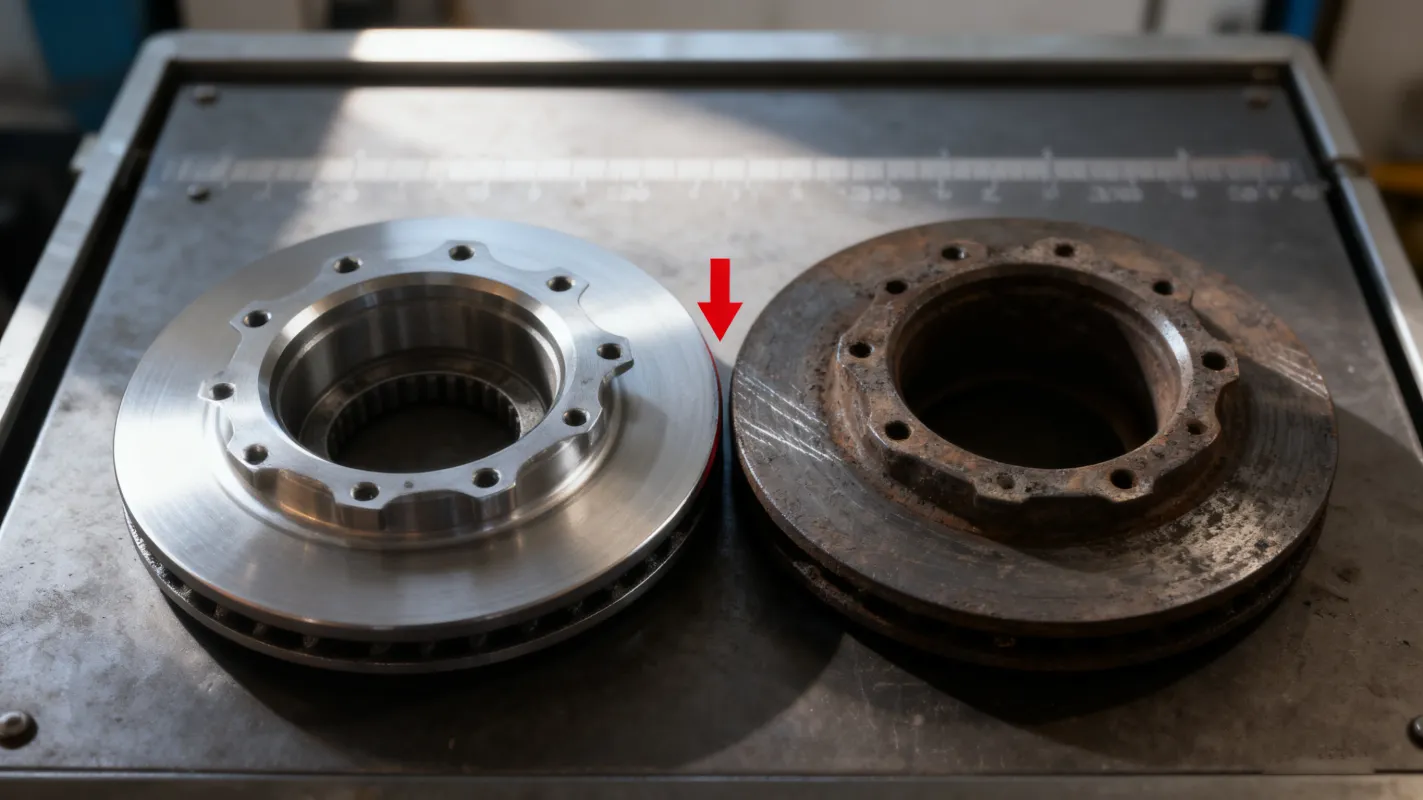
| Coating/Corrosion Protection | The humidity and storage conditions in coastal areas can accelerate rusting, affecting the quality of goods on shelves and increasing return rates. | Coating type, salt spray test data (if available), packaging specifications. |
| OEM/OES mapping and cross-reference | Incorrect installation can lead to the most expensive returns and repair shop disputes. | OE number, application list categorized by vehicle model/year/engine, and photos/drawings. |
If suppliers avoid sharing basic quality control and compatibility information, the so-called "low price" often translates into higher after-sales costs. Factory direct partners should be happy to provide transparent information—especially if you plan to place repeat orders.
Bulk purchasing is one of the fastest ways to reduce costs, but it requires a SKU strategy . Many small wholesalers try to bulk purchase by "doubling down on everything," but this often results in slow inventory turnover and tight cash flow. A better approach is to focus on purchasing high-turnover items and then gradually increase the purchase volume of SKUs that sell every week.
| step | what to do | Expected impact |
|---|---|---|
| 1. Split your product catalog | Separate Category A products (the top 20% of SKUs by sales volume, accounting for approximately 70% of sales) from Category B/C products. | Prevent funds from being tied up in SKUs with low turnover rates. |
| 2. Consolidated freight | Combine Category A items as much as possible and send them in batches or as larger packages. | Depending on the route and loading efficiency, unit logistics costs can typically be reduced by 5%–12% . |
| 3. Standardized packaging | Using standardized carton sizes and labels can speed up receiving and reduce picking errors. | Reduce warehousing and processing costs and minimize misdeliveries. |
| 4. Establish a reordering schedule | For fast-moving optical discs, a reordering cycle of 30-45 days, consistent with seasonal demand, is adopted. | Urgent orders decreased; cash flow became smoother. |
In the Middle East, demand is primarily concentrated on popular sedans, SUVs, and light commercial vehicles. If you're unsure where to begin, start by filtering your invoices from the past 90 days to create an "A-list": prioritize frequently appearing brake disc models for bulk consolidation—especially those urgently needed by repair shops.
If you want to truly reduce costs, don't just focus on "cheaper discs," but on reducing errors . In wholesale business, a single size mismatch can wipe out the profits of many correct sales—especially when repair shops expect quick problem-solving.
Assembly accuracy : Confirm the original equipment manufacturer (OE) part number, vehicle configuration, and dimensions (diameter, thickness, cap height, bolt hole spacing). It's not enough for the customer to simply say "Toyota"—the model year and engine model are also important.
Climate Durability <br />The high temperatures in the Middle East and the prolonged braking cycles on highways place higher demands on processing stability and metallurgical performance. Brake discs that perform well in mild climates may not be ideal for sustained high temperatures.
Customer profile matching : Fleet buyers prioritize durability and low vibration; retail buyers prioritize availability; repair shops prioritize compatibility and first-time success rate. Inventory is tiered based on these factors to maintain reputation and reduce claims.
Reference data: In aftermarket categories such as brake components, if compatibility matching is strictly enforced, wholesalers' return rates are typically between 1% and 3% . However, if the purchased SKUs have not undergone rigorous cross-checking with original equipment manufacturers (OEMs), the return rate may climb to over 5% . Even a 2 percentage point reduction in the return rate can significantly improve the monthly net profit margin.
We focus on the Middle East aftermarket with a clear objective: to help small and growing wholesalers establish a stable and repeatable brake disc supply chain. Our brake discs are selected and manufactured with local road conditions in mind—high-temperature environments, frequent stop-and-go city traffic, long-distance highway driving, and dusty environments.
There are no unnecessary middlemen adding to the price. Batch quality is more consistent, quality control is clearer, and planning for repeat orders is more comprehensive.
Start with small-scale new cases, then scale up successful cases. We support consolidated shipping to improve the efficiency of single-item logistics.
We offer OEM labeling/packaging options and specification matching services for wholesalers who are building their own brand image.
If you are sourcing brake discs for the Gulf Cooperation Council or the wider Middle East region and want to reduce total procurement costs (not just invoice costs), we can help you find rapidly changing OE reference numbers, confirm compatibility, and develop a stable reordering plan.
Inquire about high-temperature resistant brake discs (flexible minimum order quantity, OEM service available).Tip: Share your 20 best-selling OE part numbers or vehicle models, and we'll provide a handy starter list for your next container or mixed shipment.
By combining factory-direct sales with a strict SKU (A/B/C) strategy , total cost of goods sold can be reduced. The biggest cost savings usually come from reducing returns, reducing emergency shipments, and maintaining stable inventory, rather than simply pursuing the lowest unit price.
Always verify the original manufacturer's part number (OE number ) and confirm key dimensions (diameter, thickness, cap height, bolt hole spacing/PCD). For best-selling models, retain a verified reference list and select a supplier that can provide a clear application list and quality control documentation.
Not necessarily. Many Middle Eastern wholesalers initially use flexible minimum order quantities (MOQs) for high-turnover SKUs, and then scale up after sales have been validated. This approach ensures cash flow while establishing a stable, repeatable supply chain.
 160
|
160
|
 brake disc installation mistakes positioning hole precision turning processing commercial vehicle brake discs brake disc installation skills
142
|
brake pad replacement indicators brake performance degradation automotive brake maintenance vehicle safety inspection brake system health check
389
|
High-performance brake bolts Vehicle braking safety Brake bolt anti-fade Stainless steel brake bolts IATF TS16949 certification
386
|
brake disc selection guide gray cast iron brake disc material automotive brake disc certification standards anti-corrosion brake disc technology high-performance brake disc for passenger cars
207
|
brake kit selection guide brake kit compatibility judgment brake kit installation essentials ABS ring kit quality standards brake parts technical knowledge
brake disc installation mistakes positioning hole precision turning processing commercial vehicle brake discs brake disc installation skills
142
|
brake pad replacement indicators brake performance degradation automotive brake maintenance vehicle safety inspection brake system health check
389
|
High-performance brake bolts Vehicle braking safety Brake bolt anti-fade Stainless steel brake bolts IATF TS16949 certification
386
|
brake disc selection guide gray cast iron brake disc material automotive brake disc certification standards anti-corrosion brake disc technology high-performance brake disc for passenger cars
207
|
brake kit selection guide brake kit compatibility judgment brake kit installation essentials ABS ring kit quality standards brake parts technical knowledge