.png?x-oss-process=image/resize,h_100,m_lfit/format,webp)
.png?x-oss-process=image/resize,h_100,m_lfit/format,webp)
.png?x-oss-process=image/resize,h_100,m_lfit/format,webp)

In routine brake maintenance at local auto repair shops in the United States, brake disc latent runout and incomplete cleaning of locating holes/wheel hub surfaces are frequent causes of customer complaints. Many seemingly minor issues can escalate into steering wheel vibration, pedal rebound, squealing noises, and uneven wear within a few hundred to a few thousand miles, ultimately leading to rework and reputational damage.
"The steering wheel shakes when braking at high speeds," "It squeaks after the brake discs were replaced," "The brake pedal feels like waves," "It started shaking again just a few days after the discs were replaced." These kinds of feedback are particularly concentrated in US commuting/highway scenarios: braking vibrations in the 60–75 mph range are the most easily perceived.
A single brake rework often involves more than just "disassembly and retesting": it requires cleaning the end face again, retesting runout, re-tightening, and road testing for confirmation. Based on typical US labor hours, rework can take 1.0–2.5 hours , and there are also costs associated with customer waiting and trust.
Many instances of vibration are not due to "poor brake disc quality," but rather to rust, scale, old grease, or grit trapped between the brake disc and the wheel hub. Even a slight unevenness of 0.02–0.05 mm can create a barely visible wobble after installation, which, with heat circulation, becomes noticeable braking vibration and noise.
Misfitting end faces → Excessive initial end runout → Uneven brake pad contact → Hot spots → Thermal stress in the material → Subsequent noticeable "disc deformation/disc thickness unevenness (DTV)" sensations. The customer only remembered one sentence: "It broke right after you replaced it."
| step | Key points | Common mistakes |
|---|---|---|
| Clean the wheel hub end face and center positioning | It is recommended to use a wire brush/end face cleaning disc to treat rust, and finally wipe with brake cleaner and let it air dry; ensure that the end face is "dry, clean and flat". | Only one coat was applied, without addressing the center step; residual oil film remained. |
| Check the fit of the disc cap/center hole. | The center hole of the disc and the positioning step of the wheel hub should fit smoothly to avoid jamming; slight rust removal is necessary, but "grinding the hole" is strictly prohibited. | Forced hammering, the center hole was blocked by burrs. |
| Thin-coat rust prevention (optional) | Apply a thin layer of high-temperature resistant anti-jamming agent only to the center positioning step of the wheel hub, and do not apply it to the friction and contact area of the end face . | Applying anti-jamming agent to the entire end face can create a risk of slippage and loosening. |
Many dealerships skip end-face runout checks during peak hours: they install the steering wheel, put the wheels on, and deliver the car after a road test if everything goes smoothly. However, end-face runout is something that should be tested early to save money . This is because if the initial end-face runout is too high, it's more likely to develop into a vibration that the customer can clearly perceive after driving for a while.
Common target for passenger vehicles: ≤ 0.05 mm (0.002") ; many models have stricter requirements for assembly end runout. If the threshold is exceeded, it is recommended to first check the end face cleaning and reindexing of the disk position , rather than directly judging "the disk is not good".
If the brake pads bounce excessively, they will be "pushed back" with each rotation, creating a pedal rebound sensation; this is especially noticeable during high-speed braking, causing the steering wheel to vibrate. Customers often interpret this as: you replaced the part, but the problem remains unsolved .
| Table base position | The magnetic base is securely fixed; the dial indicator contacts are placed in the working area of the dial, avoiding chamfers and rusted edges. |
| Pre-tightening method | Use 2-3 nuts to simulate the clamping force of the wheel hub to secure the brake disc, preventing "disc drift" that could lead to inflated readings. |
| Reviewing the action | If the reading exceeds the limit: clean the brake disc before testing; then try re-indexing the brake disc by rotating it to different hole positions and compare the lowest runout point. |
| Final delivery | The recording terminal jumps data to the work order (for review and communication), and completes road testing to confirm no shaking/no screeching. |
One of the most easily overlooked details in American auto repair shops is that uneven torque on the wheel nuts can cause the brake discs to "pull off-center." In particular, using an impact wrench to apply torque directly to the floor without following the star-shaped sequence increases the risk of wheel bounce and noise, and may also affect the lifespan of the wheel bearings and braking stability.
The specific torque value should be based on the vehicle's manual (the common range for passenger cars is approximately 80–110 ft-lb ), but the process is generally the same: hand-tighten to position → low torque pre-tighten → final torque in star order after landing . If an impact wrench must be used, in order to improve efficiency, a torque wrench should also be used to "calibrate" the torque in the final step.
Many customers are unaware that brake vibration is related to torque. You can clearly explain this during vehicle delivery: we performed end face cleaning, end runout testing, and torque wrench setting . These are not "redundant steps," but key to reducing vibration/abnormal noise and requiring follow-up visits. Explaining this clearly makes customers more willing to pay for professionalism.
If you want to maintain consistent delivery even in busy workstations, we recommend printing out and affixing the following checklist to your workstation, or integrating it into your DMS (Dedicated Work Management System) workflow. Its value lies in covering the most common rework triggers with minimal steps.
| Inspection items | Acceptance Standards (Reference) | Record suggestions |
|---|---|---|
| Wheel hub end face/center positioning cleaning | No rust, no sand, no oil film; brake disc fits smoothly. | Take photos for documentation (especially useful for problematic vehicles). |
| LRO (Leg Runout) | Target size ≤ 0.05 mm (or as per vehicle model requirements) | Work order record readings and measuring points |
| Brake pad/caliper slippage | The guide pins slide smoothly, the plate holders are free of jamming, and the grease is applied correctly without contaminating the friction surfaces. | Describe any abnormal wear patterns (differences between inner and outer sheets, etc.). |
| Wheel nut torque/sequence | Torque is determined according to the star-shaped sequence; torque values are based on vehicle specifications. | If necessary, indicate "A torque wrench was used". |
| Road test and delivery communication | No shaking, no abnormal noise; execute the bed-in procedure as needed. | Explain the "preventive steps" to the client. |
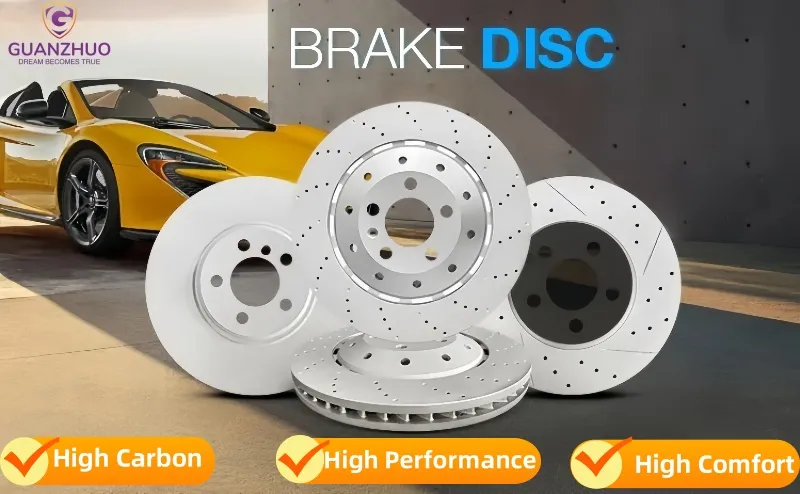
Standardized installation procedures are fundamental, but the stability of parts is equally crucial. We offer DOT-certified brake discs, covering commonly used models in mainstream passenger and commercial vehicles in the United States. Combined with local warehouse stock for rapid shipping and flexible MOQ supply methods, we are better suited for small auto repair shops and chain stores for daily inventory and emergency replenishment, reducing the risks of "waiting for parts" and "incompatible installation".
Common problems often stem from "mismatches in details": center hole fit, surface rust prevention treatment, and brake surface consistency. Stable product specifications allow you to focus your time on end face cleaning, end runout control, and torque specifications —areas that truly impact delivery quality.
For vehicles that require routine maintenance and high sales volume, small batches can be kept on hand; when customers need same-day delivery, local warehouse shipping can reduce waiting time. For stores, "controllable delivery" is itself a competitive advantage.
If you want to reduce brake rework and increase the first-time delivery success rate, you can directly request the compatibility list and stock information: covering mainstream models, with flexible MOQ, suitable for US auto repair shops to quickly stock and replenish inventory.
 273
|
273
|
 Passenger car brake drums IATF TS16949 certification R90 E - mark standard Brake product quality control Automotive brake system safety
173
|
automotive brake linings international certification VCA COP audit E - Mark certification technical requirements brake system quality management automotive parts certification standards
314
|
High - performance brake bolts Anti - fade principle Brake bolt material science High - temperature braking stability Automotive brake system accessories
389
|
High-performance brake bolts Vehicle braking safety Brake bolt anti-fade Stainless steel brake bolts IATF TS16949 certification
492
|
High-performance brake bolts Anti-fade brake bolts Automotive braking system Braking system high-temperature challenges Stainless steel brake bolts
Passenger car brake drums IATF TS16949 certification R90 E - mark standard Brake product quality control Automotive brake system safety
173
|
automotive brake linings international certification VCA COP audit E - Mark certification technical requirements brake system quality management automotive parts certification standards
314
|
High - performance brake bolts Anti - fade principle Brake bolt material science High - temperature braking stability Automotive brake system accessories
389
|
High-performance brake bolts Vehicle braking safety Brake bolt anti-fade Stainless steel brake bolts IATF TS16949 certification
492
|
High-performance brake bolts Anti-fade brake bolts Automotive braking system Braking system high-temperature challenges Stainless steel brake bolts